
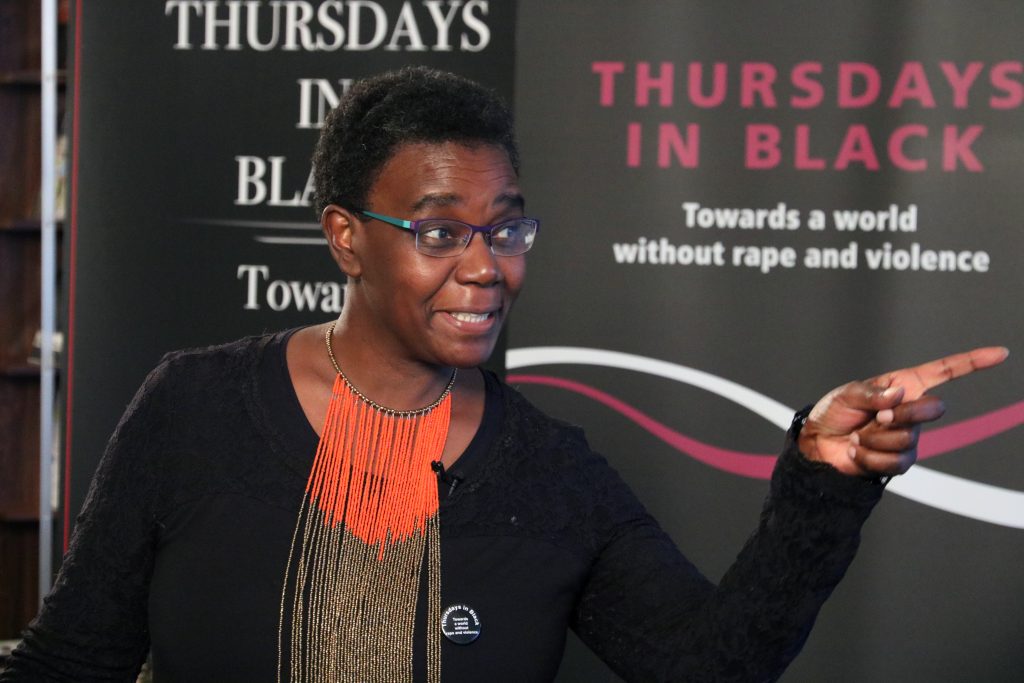
(Photo Credit: Ivars Kupcis/WCC)
Rev. Dr. Nyambura Njoroge, Programme Executive of World Council of Churches Ecumenical HIV and AIDS Initiatives and Advocacy, shared the role faith based organizations in addressing gender based violence through the #ThursdaysInBlack campaign at the #Faith2EndAIDS pre-conference to #AIDS2018.
Interview Transcript
Prof. Azza
To go from the national to the global Reverend Dr. Njoroge, your experience has been lost in this particular area of HIV AIDS and also the mobilisation around and for and with women.
Generally, tell us a little bit of the work that you’ve been stewarding for some time?
Rev. Dr. Nyambura
Thank you very much for the opportunity and since I come from the World Council of Churches, I say karibu sana since we are hosting this space.
I want to kind of give thanks to Canon Gideon Byamugisha because he described the work of the World Council this morning during the devotions and the book he referred to, we try to articulate our journey, our ecumenical journey with HIV since the early 1980saAnd within that journey, because we mostly deal with addressing the root causes.
We came to realise that you can’t talk about HIV and not talk about and deal with sexual gender based violence. And indeed, those were the days when we did not have the statistics we have today to demonstrate the link.
But we had the evidence from the people that we generate with on the ground. In our respective countries where we have our member churches, the World Council of Churches has a membership of 350 today in more than 100 countries.
And so in that experience we encounter many groups of women, in particular who are addressing their own issues, and some of those issues, is HIV snd sexual gender based violence and other issues of economic justice.
I can’t forget in 2003, when one of my colleagues from the Democratic Republic of Congo, which was referred to yesterday that. If you don’t have peace and stability. It’s very difficult to deal with HIV.
He would write a report and he would say it was very difficult to do the workshop on HIV because the topic became the source of violence In the lives of the people. And in that mixture is when the women started to say ABC (abstain, be faithful and use the condom) is not working for us because when we are raped, the chances of being pregnant, the chances of being HIV positive are always 50/50.
And some of them would testify that they are HIV positive because of sexual violence. Now in this country is what we have not mentioned when we had the idea. Presentation is the internally displaced persons and these are some of the people we encounter particularly in sub-Saharan Africa we have work. In DRC, but we also have the example of Nigeria. Where some of the states is very difficult to do the work because of political instability and many of those people are displaced in one of those contexts, we have a very dynamic woman of faith who has created a centre.
For peace initiative with her fellow women, colleagues and others. To address violence, particularly because of Boko Haram, she is from the Church of the Brethren, and in that setting she addresses all the people irrespective of their faith but faith. They are faith inspired.
And Doctor Rebecca received the award last year from the UNHCR, the Humanitarian award for how long and when she discovered that we use Thursdays in Black to talk about the violence and this the background of those days in black also comes from the grassroots where women in Argentina, Israel and Palestine, South Africa, Rwanda and Bosnia. They chose those days in black in their own initiatives and almost all of these were women of faith.
So we adopted this and made it a global campaign and you can see part of it on this screen and you are receiving the pins. So what Rebecca has done is to adopt Thursdays in Black to amplify the work that they are doing in Nigeria. They do more than create awareness. They are addressing the trauma they are listening to the women who have been raped who have become HIV positive, who become pregnant and most of the times they have to miscarry the baby.
Because of the conditions of these are women and men on the move in their own countries. So these are some of the encounters that we have experienced as World Council of Churches addressing HIV and AIDS. We did not wait for the statistics because the statistics were the people we encounter.
This centre we had a pilgimage visit to South Sudan in Juba and the women spoke. They said when our male political leaders get together with the main religious leaders to negotiate for peace in South Sudan. We are not at their table. We women of faith in South Sudan are sustaining those who are left behind. They meet once a month. Irrespective of their denominations. To pray. To urbanise to organise. To strategize and what they said to the Accompaniment that the World Council of Churches had brought with them, they said we care very much about prayers.
We care very much to be in accompaniment, but we also care very much to have our voices and our actions amplified. Can you become our microphone? At the global level, because we are big now.
These are women of faith who are not only addressing HIV and sexual gender based violence, but everything else that has been destabilised by the instability in South Sudan as a result.
Now every Thursday, as we observe, does this in black by wearing black or by using the pins that you have, because some people aren’t comfortable being in black. Those who are coming into black because of your profession, we encourage you to use the the pin because it distracts the conversation.
But on those days now, if you look at the World Council of Churches website, you find the reflections that are being posted every Thursday to accompany the women and children of South Sudan, may I say.
That the population of South Sudan is like population of children 51%. Is that at the age of 18?
So the the children you see moving out of South Sudan to the refugee comes in Kenya, Uganda and the neighbouring countries.
They are basically children who are being wrecked. They are not making it to the camp sometimes because the journey is too long. These are the voices they have asked us. Fine, we are also using this this in black in schools because children get excited with these kind of campaigns.
But they do more than where the black. In some cases we have T-shirts.
Anyway, who can’t wait to get out of school? So that he is in that space in black T-shirt to go and play with the other kids.
And so we are not just doing it as they adopt. We are actually saying stop sexual gender based violence, stop new infections because in Africa is a continent of children.
And so also children have to be involved. Please Google the statistics.
If you had added five years old in Africa you are 75% of the population. That’s what we are talking about when we talk about people.
Prof. Azza
Thank you very much indeed. Dr. Nyambura think one of the one of the many pieces of wisdom that you’ve shared that resonates is the role of women of faith.
And how that particular role can be incredibly critical?
From the acknowledgement ff what it is. That needs to happen at the global level thank you for bringing out how national campaigns can become global awareness raising campaigns, but also for informing us that awareness raising is not simply a matter of a term, but it is quintessentially about spreading knowledge and knowledge as we all know is a key ingredient of the formula of power.
And therefore the role of women of faith in being a powerful a powerful set of agents is further underlined. Thank you for that.

