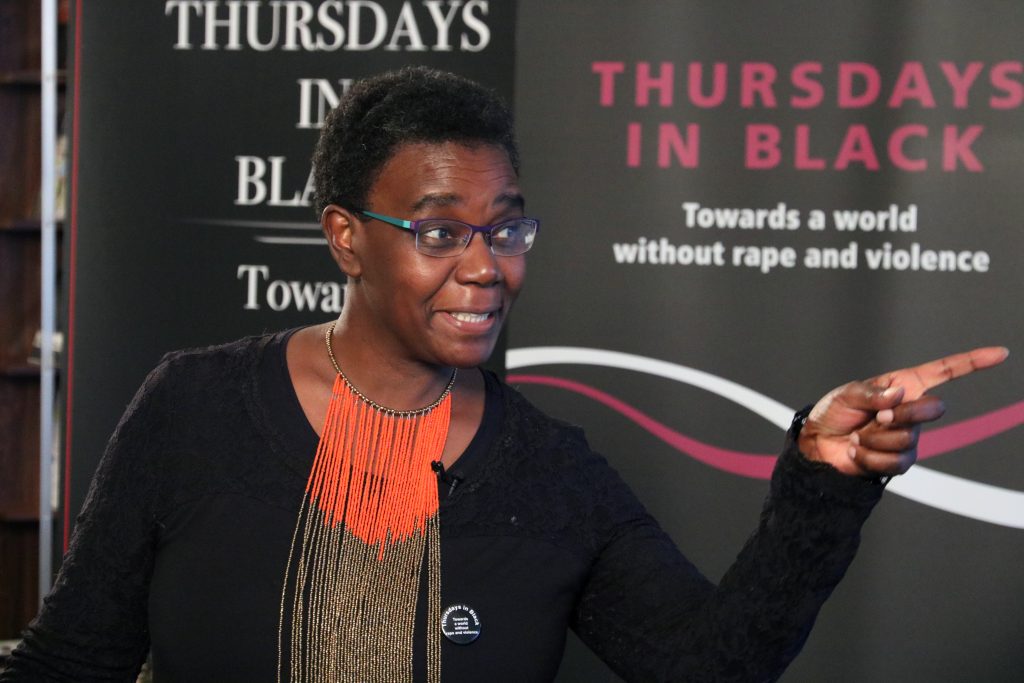

(Photo Credit: Albin Hillert/WCC)
Panelists reflected, engaged and shared on what building bridges means for them and how faith communities and faith based organizations have built bridges for a better response to HIV at this #Faith2EndAIDS pre-conference to #AIDS2018.
Forum Transcript
Facilitator
In your first experience, what are the bridges? But maybe also what are the barriers that you experience in connecting religion and the dealing with challenges?
Jacqueline Allesi
Thank you very much. My name is Jacqueline Allessi and I’m from Uganda. I’m actually the current executive director of fan HIV Foundation. Actually, I started two weeks back. Yeah so one of the things that I have made a person living with HIV. This is my 17th year but I’m 32 years but one of the things that I. I know how I would say the what does bridging?
Building bridges mean to me as a young person. I would say one of the things it means to me is giving opportunities ’cause one of the things I have done in my life is I’ve given opportunities to be able to let others be either better than me or even like me. ’cause I’ve seen very many young people who would love to be like.
I mean by they don’t have the opportunity, so the only thing that can be created is a bridge that can help them become better than me or like me. So I’m being a role model.
Facilitator
Can you explain how it works?
Jacqueline Allesi
Practically t is more of our non-stop putting yourself in another person’s shoes but being the 1st that everyone wants to look at. Sometimes it’s not about the beauty, it’s not about what you are. It is about what you think other people will benefit from? So? To me the bridging is more of putting yourself there that everyone can look at you and say if she can do it, I would say the African way. I can also did it. If she did it I can do it. Yeah, so basically that is what I can.
Facilitator
See yeah, so that also implies the willingness to to become visible. Now this runs against the notion of stigma. I mean stigma. As it tends to become invisible.
Jacqueline Allesi
Oh yeah, So what I really mean is you know you have always to be there. You have actually to be visible. One of the things I’ve done in my previous work, or even in my work right now is if we need to end stigma. We need to make sure that we have role models. I’m going to bring back the issue of role models. A role model is known about you modelling. You know when we talk about modelling and comes the African culture someone. Say oh the person has to be modelling. And all that.
What I mean here is about you doing things that inspire others to be better than you or like you so you’re not supposed to do things in the back. You’re always supposed to do things where everyone else can see and say, oh Jacqueline did that, I can also do it.
Facilitator
Thank you. Canon Gideon this notion of the role models that’s also related to to your own experience in building bridges. How does it work for you? Or would you mention other bridges?
Rev. Canon Byamugisha
Walking the talk is one of the of the very important elements in bringing in building bridges. Professor John was talking about we have the means, but do we have the will? And when you look at for example, many Scripture, many religions we have scriptures to talk about loving your neighbour. As you love yourself, do not do to others or do not say to them.
Do not even think about them. I love when you talked about but how are we thinking about how you thinking when you are?
Giving them instructions so it’s even if thoughts are you thinking about someone that that could be helpful if thought about you. So we have the ethics. We have the moral instruments we have, international frameworks for human rights we have, but building bridges is moving from the head to the heart.
To say I will I know, for example, we know that bridges are closed. That’s something that probably you have talked about. Here that when you say I’m building a bridge. If it is a great bridge to be sustainable, it has to be costly, but then you have to say I will have the commitment.
To get what it needs to be disciplined, so putting into practise what our faith we like is whatever phase is very important part of role modelling.
Facilitator
How does being a religious leader this support you in being building those bridges or is it sometimes a hindrance? How does that work for you?
Rev. Canon Byamugisha
Repeating that being a religious leader yourself does that support you in building your bridges, or is it sometimes a hindrance?
It supports me most of the times because I’m a teacher by profession. I’m a pastor by calling I’m a theologian by training.
And when I combine all of that, I find I have tools that helps me to build bridges. For example, when I was told I was HIV positive. The first thing that this man who mocked me was saying , what are you going to do? He thought that I was I was out front. But I had the scriptural, spiritual, and ethical tools to help me survive and I told him I didn’t. I don’t know what we need to do now, but I’m sure God will give me guidance on what to do. And the first thing was break the silence we open right here. Expand the image that people have about HIV. And here for them to see that my spiritual status may not be may not reveal something about my HIV status and vice versa.
When we came to forming the network of religious leaders living with or personal affected by HIV ourrtools which we had heard of says we don’t need just form a network of regions that were positive, we need to build a bridge with those who are personally affected.
So we intentionally started around interaction and networking. Then we said we need brief bridges to all people and now we are saying we need to bridge bridges with young people. So that we can empower them, train them, educate them.
This ticket is so there you go to fight AIDS in a way that is very appropriate and sustainable. So that’s why, yeah, we are cooperating connection again, and why these shows for. Let’s see.
Facilitator
Both of you, how you did you turn your vulnerability into a source for spiritual growth and for helping and empowerment for people.
Rev. Canon Byamugisha
We bought it from Philippians where Paul was saying Brethren, I want you to know that the things that have happened to me have furthered the cause of the gospel. So how do you turn these Rep their liabilities? Or challenges into resources for moving ahead and quicker and building a better world with better preachers or hope. Or browse observed data?
Facilitator
The notion of building bridges is not only crossing the religious barriers or the age barrier, it’s also crossing cultural and ethnic barriers. Can you speak about the bridges mean in that respect?
Marsha Martin
Yeah, yes, and thank you and just thank you to everybody for being here and already this morning. There have been such powerful messages, so just thank you everybody.
I tend to be a person who looks things up and picks a definition that I think will be valuable and helpful, so I’m going to share with you a few a few definitions that I think we’re talking about building bridges here, but you know, and this is really for us, right? For those of us who believe that we are working.
In this area, it’s important for us to sometimes stop and check if what we’re doing is what we are intending to do right.So I’m I’m looking up building, you know what’s a definition of building that I like and it was constructing. OK, so we’re constructing a bridge, pulling parts together.
Right, so you saw people putting the parts together but we are pulling the parts together now that’s going to ask us to work differently.
That’s going to ask us to work differently because we are engaged in pulling the parts together that we are the ones that are building the bridge.
And it does happen over a period of time.
So it doesn’t happen tomorrow doesn’t happen next week, but it happens in a continual fashion, so that’s what we’re doing. If we’re building right, we’re constructing pulling parts together and it’s over a period of time.
Then there’s another definition. See, this is the fun part. You can pick any definition you want, OK?
Incorporate and make a permanent part of a structure, a system or situation. So now we’re all here at this meeting.And I appreciate what my colleague said ’cause she’s like I was at a meeting a couple weeks ago. I’m still kind of working on for again.
Well, how do we take what we are learning here? And incorporate it on a permanent level.
Not just today.
Not just what we hear among ourselves.
But how do we Use it and make it lasting? ’cause you know when around HIV we’ve learned a lot of stuff and we walk out of the room when we did it and we forget the session we were just in and we act as though we didn’t get any useful information.
So I want to throw that open to us as we’re constructing and building. OK, the those are two definitions I thought were helpful, but then now let’s talk about the bridge, right? A structure carrying a pathway.
Where are we going?
Where are we headed?
In this particular definition, it was over a depression. And I thought, OK, HIV, we have not done so well and there’s a lot of depression. There’s a lot of not OK under this bridge, right? And so we’re not just going over. We’ve got to really pay attention to what we’re crossing.
When we’re building this bridge, right?
A time, a place, a means of connection.
And transition and I thought that was an interesting one of a bridge. Do you think about a bridge that way that it is a place and a means of connexion? So it’s not a structure at this point, it’s me and you.
And it’s a process of transition. We’re going somewhere. Remember, over time we’re building something and then finally, the part that I really like the best, which now comes to the real answer to your question.
Facilitator
I hope so, yeah.
Marsha Martin
A connection that joins different parts.
OK.
We’re not the same. This part is over here. That part’s over there. And we’re going to now connect it. That means we’re going to have to have a way. To interact across that bridge, we have to know each other. We have to spend some time with each other. If we’re going to have this connection.
And we have seen in HIV that is all of us. It is all of us everywhere. Every one of us where the degree of diversity is extraordinary. And we celebrate it at times and other times we reject it.
Other times we are afraid of it. But now we are at a meeting that is telling us we’re going to build bridges and I’ve just given you definitions that say we’re connecting the different parts.
And you already heard testimony this morning of how people have learned to be with with each other and that is really our challenge.
Facilitator
Thank you.
So I really loved those definitions. Well, keep in mind for once, once like Jack one further question, I really like those those definitions and the symbolism that that’s involved in it.
I would like to ask you to say a little bit more about the ethnic and the interethnic aspects of that diversity, because I think that’s also a crucial element in in.
Marsha Martin
Well, yeah, it’s it’s a very crucial element and I wanted to show this image there’s a T-shirt and I don’t know if any of you have seen it.
Uhm, but it says Just now I have a picture of it and I was going to ask that it be shown but the the image of the the T-shirt and this is now about, you know, ethnic racial differences.
T-shirt says “Why be racist, sexist, homophobic or transphobic when you could just be quiet?”
We are challenged by ethnic racial differences. We created a global network of black people working in HIV because the majority of people living with HIV and impacted by this world in this world at this point are people who are black.
The majority are. And yet we do not have the integration of Black African American, European leadership and engagement in the epidemic response. Just look around.
And we begin to understand that there are racial and ethnic differences and tensions, and we’re going to talk about it tomorrow. We talk about people on the move and migration and the challenges around migration.
We are not so comfortable with engaging the other. And so the global network got created as a vehicle for black people. Around the world. The diaspora to come together and talk about how we might want to strategize around. Addressing HIV among all people. But most certainly among black people.
And sometimes it’s necessary to have affinity in understanding what we need to do right, and at other times it’s important to crossover and bridge those differences and understand the similarities and the work that we are to do together so you know the politics of ethnicity and race and class and.
Other in HIV I believe is what we’re being asked to do within the faith context we have to deal with it.
Facilitator
Thank you, thanks so much.
Jacq finally, from your perspective, what would you say are major challenges for building these bridges.
Jacq Carver
Shabbat Shalom.
First off, the major challenges. Which is creating an ongoing awareness, especially among our queer youth that prevention is something they need to think about, and also, especially within the Jewish community. The biggest problems within the Jewish world is not within the progressive movements, but are among Ultra Orthodox are all Hasidic.
Because a lot of the kids then queer youth. Uhm, they don’t get sense of education and what sex education there is is certainly not in Yiddish.
This needs to be addressed and a lot of the kids who go off the dead are who go who leave their communities because they’ve been ostracised because of their sexual orientation. Become sex workers frequently homeless.
And who are very, very vulnerable and so one of the things that is essential is to build a wider bridge. Rabbi Nachman said the entire world is a very narrow bridge. The essential thing is not to have any here and so, one of the things that we work toward is to build a wider bridge and to reach out from.
Progressive queer communities and progressive queer Jewish communities to reach out to people who have left there.Orthodox and Ultra Orthodox backgrounds, so it’s that’s what’s really essential. It’s it’s reaching out and connecting.
Facilitator
Thank you so much, so I think what I hear from this is that there is. It was in each tradition you speak about further juice tradition. But for each tradition, there’s always this. This challenge between more progressive views, open views, and on the other, and also the more more conservative. Even fundamentalist views that make it almost impossible to speak about these issues.
So I’m going to ask before we move to the next part of the this whole session I’m going to ask you to to maybe give one message each which is important not just for your own.
Maybe open minded community, but for the wider community, including the more conservative parts, what Iss the message that you want. You want to give to them just in one sentence.
What do you need to convey from this conference?
Jacq Carver
I would convey that we are all bets elemental him. We’re all created in the image of God and to be visible, to stand up and be a queer nonbinary Jude everyday.
Facilitator
Be visible, thank you, Marsha.
Marsha Martin
I would like to invite you who as a senator has integrated all these aspect of your life to the United States and demonstrate what good senators can do and be and how they can lead in ways that we need leadership.
Facilitator
If they let me in, I will mark that.
Rev. Canon Byamugisha
I come from a Christian background and my Jesus said if you love those who love you. Those who are known to you. What is the use?
Love your enemies. Love strangers.
We are at a point where we are being invited to love people who are strange to us.
In the way they believe in the way they behave in the way the values are not easy for us, but we are challenged to love, and I think that’s the love that we concatenate to go into, to build bridges of love, solidarity and hope with people who are at risk. The families who are vulnerable.
Brothers and sisters, that challenge can. We grow a lawful revolution, a love movement that is big enough than stigma and great enough to bring the human rights and human beings that scare that can not only end AIDS, but sustain the end of AIDS.
Facilitator
Thank you. What I hear is making connections to make the efforts to connect to people are really different and more complicated. To do so, though only works in your own safe bubble.
Jacqueline Allesi
My message would be God is the same today tomorrow.
Every every time on every day. One thing that I want to just question what kind of sage true love is never resist.
True love is always real, regardless of whatever you do or whatever you are.
Let’s continue appreciating the fact that you know we’ve come together to fight what is now called.
If rates I know we can get, we can get there. We’re looking at ending ends by 2020, 2020, which is actually not very powerful from from today.
So let’s love each other. Let’s work together. I know we can’t do it. It’s a matter of just walking together the bridge.
Is always built with love with understanding and with materials, by the way, so the materials are us, the materials is what we are now looking at. So the materials is what we need to look at. So thank you very much.
Facilitator
Thank you, Jacqueline. Thank you all for your contributions on this.