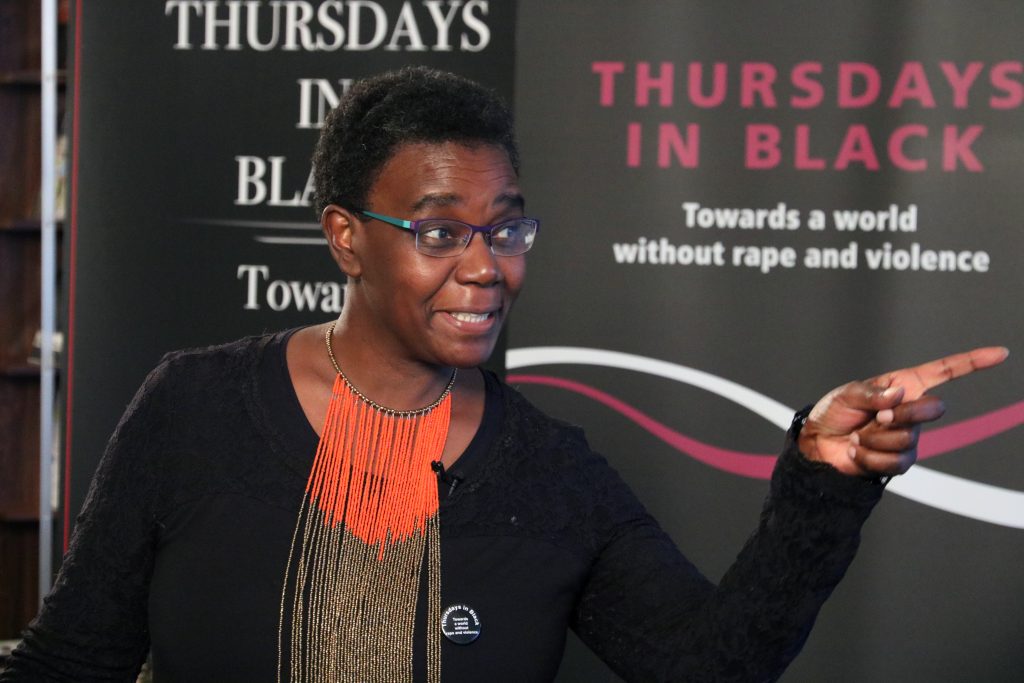
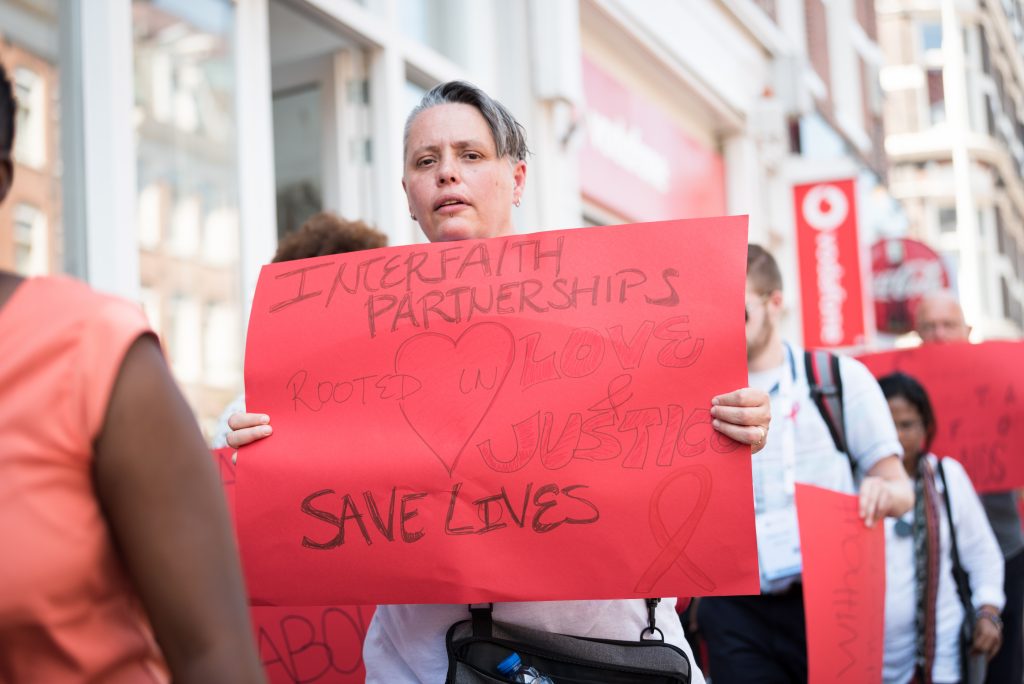
(Photo Credit: Albin Hillert/WCC)
Panelists shared what faith communities and faith based organizations should be doing differently to build bridges – of dialogue, exchange, mutual understanding, respect and collaboration at the #Faith2EndAIDS pre-conference of #AIDS2018.
Forum Transcript
Facilitator
On the on this panel, which is, uh, because the the key question will always be what is your message to the participants and what can we bring home from this conference, but let’s maybe focus on the the the crucial questions of working together. What can faith based organisations and faith communities where they are. What can that particular role be in working towards the struggle against HIV?
Yeah, medical organisations and governments. We can all work together.
But what’s the specific role of faith-based organisations and faith communities? Maybe you can take that microphone.
Speaker 3
And thank you very much for the introduction. Maybe the conversation is easier here because we’re all starting from the fact that faith. It’s difficult in a development setting or when we speak to a secure secular or non faith actors on why faith matters.
I will borrow the symptoms that Doctor Sonal shared.
It is when people are scared when people are facing certain difficulties in their life. That’s when they realise that they need that spiritual support, and unfortunately this is the context that governs our work as developed.
And humanitarian practitioners is the time of crisis catastrophes that people look for that emotional support and that support is translated through faith leaders. In some communities they are automatically given the power and authority to share to shape the narrative and the conversations.
It is both ways. It could be positive and negative, but we, as faith-based organisations, chose to knock the door they are the gatekeepers we chose to work with them to shape the narrative to break that stigma and to build awareness in communities.
And I think this is the unique role that us as faith-based organisations play is that we bring stakeholders together. We bridge the gap we bring.
Faith leaders, religious leaders as well. Most practitioners and community members to start that dialogue.
Facilitator
Represented as one of those faith leaders, so I’m sure you would agree to this. What’s the challenge to work within face, community and to deal with this face dimension?
Speaker 4
Whenever I’m in this kind of setting, I find myself dealing with the reality of what people refer to as preaching to the choir, but I would tell anybody who has been in a congregational setting where you have a choir. It’s important to preach to the choir.
Because very often the choir becomes comfortable. With the fact that because they are reading a script and they are singing a song that somehow is already established in the sense that what they’re doing is alright. Let me tell you a quick story. In our community there is a family.
They’re both Caucasian, both White, who decided a number of years ago to adopt A mixed race child African American.
They decided after about two months that there was a way in which it was necessary for them to make sure that the cultural experience of this child was such that they were not uncomfortable or somehow unappreciative of the cultural dynamics of the African American community. They decided to bring the child church.
At least once a month and sometimes twice a month, the mother was a attorney as my life is and the father was a minister.
So they would bring the child back and forth. They did this for about two years and finally after two years when it seemed like they were doing all the right thing, they decided it was important to ask the child where they want to go?
And on a Sunday morning they asked the child.
Where do you want to go?
And her response was. Do I want to go to the loud church or do I want to go to the quiet church.
Now I tell you that story, because I think that a part of what makes it hard for us. A lot of times to work as effectively as we need to, and can is that we are carrying this burden of the ways in which racism, sexism, and classism manifest itself, and what that means for us very often culturally.
Is that it’s hard for us to really achieve affectively working together.
There’s a way in which I would say that a part of what’s most important for us to do is to get to where we want, get beyond the sense of it’s to them today and to those who are the ones who are problematic in terms of us coming together and working. It’s easy to say it’s this wing, it’s the right. It’s it’s this particular group within the church. But really, I think what we start to realise it really is us as much as anyone because this virus that I like to refer to racism and sexism and classism as being is one that we care in a very unconscious way, and when we do that, what it ends up translating into is that in terms of doing those things that give us the long term ability to deal with building these bridges, we need to build only happen when we start by, and I’ll quote the great philosopher of the 20th century.
Michael Jackson, like when when he said when we looked seriously at the person in the mirror,
Because then, as we unpack some of what it is within ourselves, then we’ll be able to understand what it is that we can do within for each other.
Facilitator
So then what do you do concretely as a religious leader for your congregation to raise that awareness, especially in light of the crisis?
Speaker 4
I think that’s the first thing is to be willing to deal forthrightly with. The way in which that virus matters. Is that within us? I like using the the, the the metaphor of racism, sexism class as a virus.
Because it is very much like what we did with HIV. And trying to address it, it’s probably more complicated than which, uh, the. The thing that brought me to HIV and still compels me in terms of my passion is the realisation that we deal with it effectively.
Then we’ll deal with these other deals with seemingly, systematically undermine and keep us from being the people who should bring the power, and in fact.
We do break so in that sense, and then my my part that I think I always live with is that I don’t like to spend time pointing at the contradictions without having the real clear sense. One of my favourite quotes from Alex Fuhrman is. He says that none of life contradictions are final.
Because it’s so we have to be bold enough to face the contradictions to deal with the issues and the way in which there manifests within ourselves, and then understand how we forthrightly go together to address.
Facilitator
Thank you, thank you so much. When I think of the RC, I have to say my own name but. I was there in April in Newcastle and was impressed by the country, partly because the major problems in terms of the lack of a proper government functioning and so on. So for you my question would be directly related to that.
What do you think that the the faith-based organisation trade communities within the RC can play to take our role in in raising awareness, reducing stigma and And reducing the risk of HIV AIDS.
Speaker 2
Thank you so much. Have pointed out to be a big issue in their seats for humanitarian issues. The country has a close to 10 million people were living in the extreme. So it is a very big challenges in my country because since 2000, 1994. There is huge crisis, but I want to to set that while the public health facility were collapsed where faith-based organisation continued to provide services and I think payroll is ready to build the bridge in service delivery.
For people and key population and vulnerable populations. But for that they need to use their competitive advantage. I think it’s very important and how we can to give a shared experience use with comparative advantage and to continue to deliver the services.
And what is important to also to mention is the fact that some issue, as we mentioned, such as of a human rights violation, stigma and discrimination and also some services like providing PMTCT also in the difficult context.
In DRC, as you know, we have limited access even to areas because of insecurity with cost of transaction was very very high. The difficult to reach people and also the fact we have had conflict also in this.
But even that I think we have to face with Facebook. I come here to be here facing day by day-to-day difficulties.
Facilitator
How do they operate? Practically how things actually work is impressively.
Speaker 2
Practically, I can give a concrete example, for example. Some faith based organisation has a separate citizen, even with press variation of global fund. So we have to manage the grant to rich people and one more thing is the gender based violence also we did a staff and sensitive issue, but we fed by organisation have a strong voice.
To say human rights need to be protected, you have to be protected and also we try to gather added to pointed out some issues related to or even to be democracy which lack in this country so is it’s not easy, but I would like also to to add some. Some something is cultural barriers across the country with this staff issue, but if it is, I think the faith based also can play a key role in breaking with cultural barrier.
But prevent people to access to treatment and sometimes but expose people to infections right here.
Facilitator
How is World Vision tap into the the spiritual resources to reach its aims in the terms of the HIV?
Speaker 5
Thank you very much for your question and thank you.
For giving Worldvision opportunity to be here.
I just want to say that within the faith-based organisation where I’ve been based organisation there is untapped resource in terms of the people in the church or interfaith groups, the platforms to use.
The clout we have the power we have to be able to reach to people, people both healthy and seek in their church and it’s an opportunity for us as we work with them to maximise the the potentials to really build these bridges across to to enhance and treatment access to people living with HIV.
We collaborate right now and one of the things I think an important bridge to always process build this relationship not just build but maintain it transparency and accountability.
Respecting people’s ethics and religious beliefs, we work with interfaith.
Across all religions, depending on the countries we are working with and and respecting those relationships, those bridges and having a common goal that the ultimate goal is the well-being, the total well-being in faith and in health of the communities we serve and working with them to make sure that.
People services are representative is really very very important.
And I want to say in our work, sometimes we we need to move from comfort zones where we’re very comfortable in the church like we talked about preaching with require, but outside the church. How are we comfortable in talking about these issues or dealing with them? So we really need to enter into inconvenient zones. Those things we can’t talk about or we don’t want to see you or do we need to get engaged?
Get our hands dirty and make sure that our congregations, irrespective of our faith, are healthy in faith and spiritually.
Facilitator
Maybe linking to that question, and because that’s one thing for me that runs through this and this entire morning. What we heard on the positive inspiration that people find in their face traditions as I think some of the crucial elements in that we need in the challenge that we need to overcome has to do with the the moral perspectives and the moral positions that many face community stake when switch Rs as drugs use when it’s regard sexuality and it’s immediately related to to tackling HIV, AIDS crisis and raising awareness.
And I don’t like to ask each one of you. How can we confront those, sometimes very massive moral positions and find more or more space to to negotiate these issues so that we can reach people there?
Speaker 3
I think that in in every religion. Especially faith leaders sometimes think that they are The Walking Quran or Bible. They are the role model as was mentioned before, but the factors were all minimum blades. None of this is an Angel in here. Otherwise, it would have been heaven, even though it’s as beautiful as maybe, but I think that there is an awareness among faith leaders as it has been said by one of the imams in an AIDS conference.
He said the role of a faith leader is to educate, build awareness, and it’s the same to neglect.
That responsibility so we need to work on that last part , if they neglect their main responsibility to educate people and how to remember AIDShow to deal with it and most importantly it is not a punishment from God. It is like everything else in our life, some of us are rich some are poor.
Some were born with disabilities, so or not this is one of the things that are an added vulnerability to us as human beings.
And I would like to add as faith-based organisations were also NGOs and we work in the humanitarian sector. I asked myself because Islamic relief is a mainstream organisation right now specialised in health isn’t really our space.
But we found ourselves that we are committed to leave no one behind agenda. I’m trying to speak in the development language, which means that by definition we are committed to leave no one behind, including people who are HIV positive. It is our mandate. It is the mandate of any organisation that is working in development or humanitarian.
And I would like to admit it is our role to create an evidence base because we say that faith matters really, how, why do we have evidence?
Do we have researchers that can validate what we’re saying? It is our role to build that evidence space. And and finally, if you may allow me.
But faith it matters because it is part of our identity as human beings. As simple as that but. If if you may allow me, I’m not here to represent 1.8 billion muslims around the world, so we need to create that interfaith dialogue. We’re speaking here about interface, but there are a lot of heterogeneity among people from the same frame.
A lot of intersectional factors .There are maybe sometimes more difficult.
Facilitator
All have to go back to our own communities, whichever they are and and tackle the the the challenges in there as well and they.
Speaker 4
Really appreciate your comment because one of the things that that happens for us is that.
We do end up sometimes thinking that because of the ways in which we have been trained in the ways in which we have come to understand.
And our experiences and our different faiths. That somehow that’s it. There’s a slide I use on every presentation I do where it says the real issue is how we experience with the people that we serve and and address the whole experience of how to think persons what to think.
So much of what goes on in the church is all about and what goes on in faith communities period is what to think. So in the Muslim community there people will tell you what to think.
The question to be the what to think Jewish community, what they think the issue is, how to think, and how to think sometimes requires that you are an agent that has as a purpose too.
To create attention that allows people to move outside of the frameworks that perhaps in too many instances represent the barriers that we’re trying to move beyond in order to be able to have this collaborative experience. And I’m one of those quotes that tries to make.
Sure, but that’s what we do all the time. As a matter of fact, I have a thing that I say to preachers all the time and to. People who speak but only in the name of the Lord always said you think you said that you can be sure you did.
If you think you know it, you can be sure you don’t because what we’re dealing with when we’re talking about divinity, and we’re talking about God.
Then we have the ultimate capacity. We’re always pushing people and and encouraging people and creating an environment in which the new thought which is needed for the moment and for the day can come forth. But if we try to always make it fit in that tradition that we’ve had and accepted all of our lives. We very often are going to end up not being able to breakthrough to that next level of understanding of how it is that we work together to achieve what I think can be some sense of common ground that allows us to go forward.
Facilitator
Thanks very much, Mark. What do you think? Some message that we all should bring from this conference to our home communities? What is the message we should bring in order to overcome those barriers?
Speaker 2
Thank you, I have two messages. One is a thing is the peace is very important is and stability.
Without peace and stability I can say it’s very difficult. Even if you are committed to deliver.
The second thing is regarding the morality, I think.
Even you are injecting drug users, if you are sex worker.
For me, we all have to see the human before the 1st and we have to help them. We have to make what we can do to facilitate the access of the services.
I think which with two messages I. want to to share with the participant and we have to take back peace and human rights. Thank you so much.
My message is that this is a unique opportunity of building bridges so and this conference setting the pace for a lot of things will be hearing, so I’m requesting that we look at collaboration partnership.
Be open minded to look at innovative things we could bring into our congregations or to the programmes we run to improve their lives. And also remember that. We cannot do this alone. Partnership with the Gov. Meant partnership with everyone is very, very necessary and that’s why we continue to mobilise, to to advocate, be resourced to be able to really do this, and I believe also the the faith platform is an untapped one and not just the spiritual messages that could come out of their health.
And the aim is to have a healthy congregation, be it spiritually financially. As well as health issues. So let’s listen. Let’s partner. Let’s collaborate and. We hope we can bring that to our conversation when we go back. Thank you.
Facilitator
Thank you so much for your contributions.